Turkish Citizenship by Investment
Legal Guide for Foreign Investors (2026)
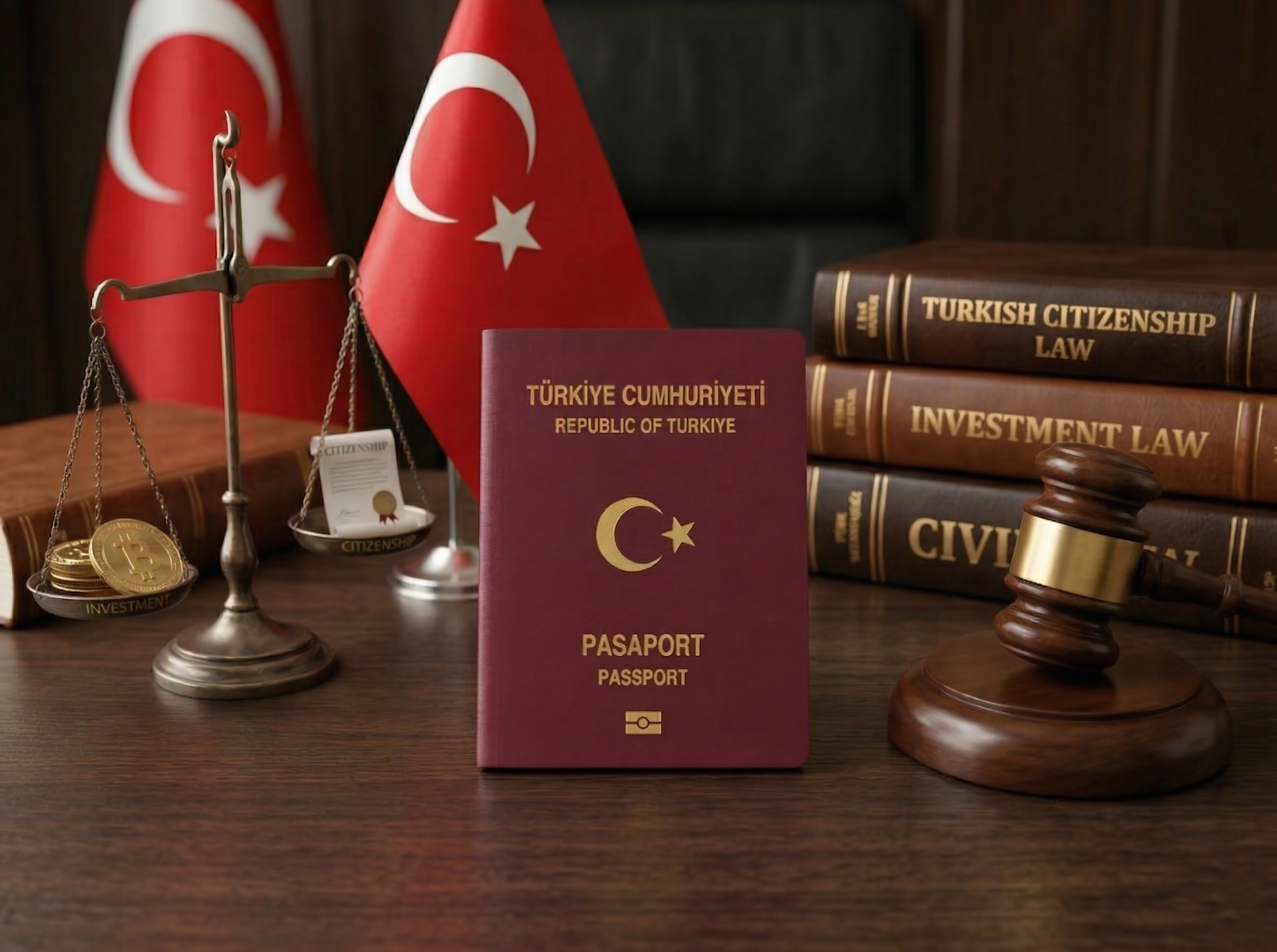
Foreign individuals can acquire Turkish citizenship in exchange for investing in realty, securities, or job creation — without ever having to abandon their existing citizenship. Unlike most other programs, Turkey requires no donation to the state and places no restrictions on asset type or location.
Licensed 2016
Turkish Citizenship by Investment — Legal Framework
Turkey's citizenship by investment program operates under Law No. 5901 on Turkish Citizenship and Presidential Decree No. 106. The program has been active since 2017, with the minimum investment threshold revised to its current level in May 2022.
Unlike most other citizenship by investment programs, the Turkish program requires no donation to the state, does not mandate investment in government-appointed areas, and does not restrict investors to low-value assets. The investor retains full ownership of the investment and may withdraw after the required holding period along with any accumulated profits or interest.
Turkey allows dual citizenship. Obtaining Turkish citizenship does not require renouncing an existing nationality under Turkish law. Language proficiency in Turkish is not required under the investment route — it is only a requirement for other types of citizenship applications.
Obtaining Turkish citizenship through investment does not require language proficiency, residency, or renunciation of existing nationality.
For foreign nationals who prefer a residency-based pathway rather than an investment route, a separate application process applies. See: Turkish Citizenship by Residence
Unlike many competing programs, the Turkish program involves no mandatory donation. The full investment amount is the investor's own asset and is returned after the holding period.
Turkey permits dual citizenship. Acquiring Turkish citizenship does not require the investor to renounce their existing nationality under Turkish law.
Turkish language proficiency is not required for the investment route. All documentation and processing can be managed through an authorized attorney.
Physical presence in Turkey is not required during the application process. The entire process can be managed remotely through a notarized power of attorney — except for biometric data collection.
Qualifying Investment Options
Four investment routes qualify for Turkish citizenship. All four involve a minimum holding period of three years, after which the investment is fully returnable to the investor along with any accumulated gains.
Real Estate — $400,000
The most commonly used route. Three conditions must each independently meet or exceed $400,000: the sale price paid by bank transfer, the SPK-licensed appraisal value, and the declared value at the title deed office. A gap between any of these three figures prevents the Eligibility Certificate from being issued.
The seller must be a Turkish citizen or Turkish legal entity with no close family relationship or business connection to the buyer. Both residential and commercial properties qualify. Multiple properties may be combined — each must carry its own SPK appraisal report. Used and secondary market properties are fully eligible. Off-plan purchases are accepted if the project holds a valid construction permit and payments are made through a Turkish bank account.
Turkish bank loans cannot cover any part of the $400,000 minimum. They may be used for amounts above the threshold.
Bank Deposit — $500,000
A minimum of $500,000 USD — or the equivalent in a foreign currency accepted by the relevant authority — must be deposited in a Turkish bank. The investor signs a notarized commitment not to withdraw the funds for three years. The deposit is confirmed by a bank letter submitted as part of the Eligibility Certificate application.
No property acquisition is involved. The deposit route operates under Article 12 of Law No. 5901 and Article 20 of its implementing regulation. After the three-year holding period, the full deposit plus any interest accumulated is returned to the investor.
Important: The YUVAM foreign currency deposit scheme — which previously offered an alternative mechanism — was closed to new applications in 2025. It is no longer an eligible route. Any advisory suggesting otherwise is out of date.
Capital Investment — $500,000
A fixed capital investment of at least $500,000 in Turkey, confirmed in writing by the Ministry of Treasury and Finance. The investment vehicle must be documentable and must constitute a direct capital contribution to the Turkish economy.
This route is less commonly used because the documentation requirements are more demanding and the Ministry confirmation process adds an additional administrative layer. It is primarily relevant for investors who are establishing operations in Turkey rather than acquiring a financial asset.
What Rejects Applications
Several conditions are not immediately obvious from the program summary. These are the rules — some introduced through regulatory changes in 2024 and 2025 — that directly cause Eligibility Certificate rejections and application delays in practice.
Understanding these before committing to an investment is more consequential than the investment decision itself. A property that does not satisfy all three valuation checkpoints will not produce an Eligibility Certificate regardless of how much was paid.
All three figures must independently meet or exceed $400,000: the sale price paid by bank transfer, the SPK appraisal value, and the declared value at the title deed office. If any one of the three falls short — even marginally — the Eligibility Certificate application will be rejected. The most common failure point is a gap between the sale price paid and the SPK appraisal value.
Since 2024, the spouse must independently obtain a short-term residence permit before the citizenship application is submitted. This requirement was introduced by regulatory amendment and is not yet reflected in many published guides. Failure to complete this step before submission is a direct cause of rejection and cannot be remedied after the application is filed.
The YUVAM foreign currency deposit scheme was closed to new applications in 2025. Advisors who continue to list YUVAM as an active citizenship route are working from outdated information. Only the standard $500,000 fixed deposit at a Turkish bank remains available under the deposit route.
The full $400,000 minimum must arrive as a direct bank transfer from the investor's own account. Turkish bank financing cannot cover any portion of the minimum threshold — this is verified during the Eligibility Certificate process by the Land Registry. A Turkish bank loan may be used only for amounts exceeding the minimum.
If the investment property is used as the registered address for the residence permit application, it may not be rented out during the permit period./p>
Ready to proceed?
Discuss your investment route with Av. Baris Erkan Celebi
Antalya Bar No. 6134 · English-speaking · Available by email and WhatsApp
Citizenship by Investment Legal Services
Turkish citizenship attorney Baris Erkan Celebi and his Antalya citizenship law firm provide full legal representation to foreign nationals throughout the Turkish citizenship by investment application process. Services include the following.
Property Background Check
Conducting thorough due diligence on the property to confirm eligibility for the citizenship program and verify the absence of debt, mortgage, or reservation that would affect the application.
Real Estate Law →Contract Drafting & Review
Drafting and reviewing all agreements between the investor and the seller or developer, including the purchase agreement, payment schedule, and any additional commitments specific to the transaction structure.
CBI Overview →Payment Security & Title Deed
Securing the payment through appropriate bank transfer channels and registering the property in the investor's name with the correct title deed structure — including the three-year no-sale pledge.
Real Estate FAQs →Eligibility Certificate Application
Applying for the Eligibility Certificate through which the state formally recognizes that the investment qualifies for the citizenship by investment program. This step is the gateway to the residence permit and citizenship application.
Full Process →Residence Permit & Citizenship Application
Obtaining the investor's residence permit and subsequently applying for citizenship on behalf of the investor and any family members to be included in the application — from document procurement through final submission.
Immigration Law →Passport Issuance
Upon citizenship approval, applying for the Turkish identity card and passport in the correct sequence. Coordinating the final stage of the process so the investor receives all documents without procedural delay.
Process FAQs →How the Citizenship Application Works
The citizenship by investment application follows a multi-agency process involving the Land Registry, relevant banking authorities, the Directorate General of Civil Registration and Citizenship (NVI), and ultimately the Presidency of Turkey.
The process can be managed entirely through an authorized attorney by power of attorney. Physical presence in Turkey is required only for biometric data collection — fingerprints and photographs.
2026 Updates →Select the investment route. For real estate: conduct background check on the property, verify eligibility, confirm absence of encumbrances. Agree terms with seller.
Pre-ApplicationObtain a mandatory valuation report from an SPK-licensed appraisal firm. All three figures must meet or exceed $400,000: sale price paid, appraised value, and declared value at title deed office.
Real Estate Route OnlyAttorney applies for the Eligibility Certificate from the Land Registry (real estate) or relevant authority (other routes). This formally recognizes the investment as qualifying for the program.
NVI · Land RegistryAttorney applies for an investor-category short-term residence permit. Since 2024, the spouse must independently obtain a separate residence permit — this step is now mandatory before the citizenship application.
Law No. 6458Full document file submitted to the Directorate General of Civil Registration and Citizenship (NVI). Security investigation and background check conducted. Case escalated to Presidential approval.
Law No. 5901Upon Presidential approval, the investor applies first for the Turkish identity card and then the Turkish passport — in that order. Timeline: 3–6 months from complete file submission. Upon completing the process, the applicant receives a Turkish citizenship card — the identity document confirming citizenship status — followed by the Turkish passport.
NVI · Passport Authority
Baris Erkan Celebi
Attorney at Law · Antalya Bar No. 6134Baris Erkan Celebi exclusively represents foreign nationals and international companies. Consultations and all client communications are conducted in English at a professional level — without reliance on third-party interpreters. This eliminates the communication latency that characterizes translation-dependent representation, particularly at legally critical moments such as appraisal disputes or title deed registrations.
In citizenship by investment matters, the practice handles the complete process from investment due diligence through passport issuance. This includes property background checks, Eligibility Certificate applications, residence permit proceedings, citizenship applications for the investor and family members, and coordination with banking and land registry authorities.
Governments from the United States, the United Kingdom, Germany, Canada, Norway, and Belgium frequently refer their citizens when legal representation is required in Turkey. The practice also maintains membership in the TEN-Law European Network, enabling coordination with counsel in other jurisdictions where cross-border matters require it.
- 2011American Robert College — Merit Scholarship Graduate
- 2014Jagiellonian University, Faculty of Law — Exchange Program
- 2015Istanbul University, Faculty of Law — LL.B.
- 2016Antalya Bar Association — Admitted, License No. 6134
- 2019Founded Celebi Legal — Internationally Oriented Practice
- 2020Bahçeşehir University — Master's Thesis Completed
- 2020Authored: Defect in Yacht-Building Contracts
Frequently Asked Questions
Is the $400,000 real estate threshold still valid in 2026?
Yes. The minimum appraised value for real estate investment remains $400,000 as of 2026. This threshold was set in May 2022 and has not been revised since. Any representation suggesting a change in this figure is inaccurate.
Can I combine multiple properties to reach the threshold?
Yes. Multiple properties may be combined provided each carries an individual SPK-licensed appraisal report and the combined appraised value meets or exceeds $400,000. You may also co-invest in a single property with another investor — each investor's individual share must independently meet the minimum threshold.
Does my spouse need a separate residence permit?
Yes. Since 2024, the spouse must independently obtain a short-term residence permit before the citizenship application can be submitted. This requirement applies regardless of whether the spouse is included in the citizenship application and cannot be delegated to the primary applicant's permit process.
Is the YUVAM account still available?
No. The YUVAM foreign currency deposit account scheme was closed to new applications in 2025 and is no longer an eligible route for citizenship by investment. Only the standard $500,000 fixed deposit remains available under the bank deposit route.
Can I use a Turkish bank loan to fund the $400,000?
No. Turkish bank loans cannot be used to cover any part of the minimum $400,000 requirement. The full amount must arrive as a direct bank transfer from the investor's own account. A Turkish bank loan may be used only for amounts exceeding the minimum threshold.
How long does the process take?
The citizenship application may take up to six months depending on the season. Once all documents have been procured by the investor, the process typically takes around three to four months. No guaranteed timeline exists — any representation to the contrary is inaccurate.
Can I sell the property after receiving citizenship?
The three-year sale prohibition is registered on the title deed. After this period expires, the property may be sold without affecting the citizenship status. The investment is retained in full and any accumulated value belongs to the investor.
Does Turkish citizenship grant visa-free access to Schengen?
Not directly via a standard passport. Turkish citizens who hold special passports — issued to businesspeople and lawyers among others — may enter all Schengen countries visa-free. Standard Turkish passport holders do not currently have this access. Turkish passport holders have visa exemption with 72 countries, may enter 37 more countries by obtaining visas at the border, and 10 more through online visas. Turkish citizens who hold special passports — issued to public sector employees, businesspeople, and lawyers — may enter 111 countries visa-free, including all Schengen countries. Figures are subject to change over time.